On 5 February 2026 a treaty expired and most of the world barely noticed. New START was the last agreement limiting the strategic nuclear weapons of the United States and Russia. When it lapsed, the two countries that hold almost 86% of the world's warheads1 were bound by no numerical limit for the first time in more than fifty years. The UN Secretary-General called it a grave moment the day before.2
That is not how this story was supposed to go. In October 1962 the world came as close as it ever has to nuclear exchange. The decades after were mostly a story of pulling back: fewer warheads, more treaties, more phone lines between capitals. By 1991 the Doomsday Clock stood 17 minutes from midnight, the farthest it has ever been. In January 2026 it was set to 85 seconds, the closest it has ever been.3
This piece traces how the danger came down, why it has stopped falling, and what a simple numerical model says about where we are now.
How the danger came down
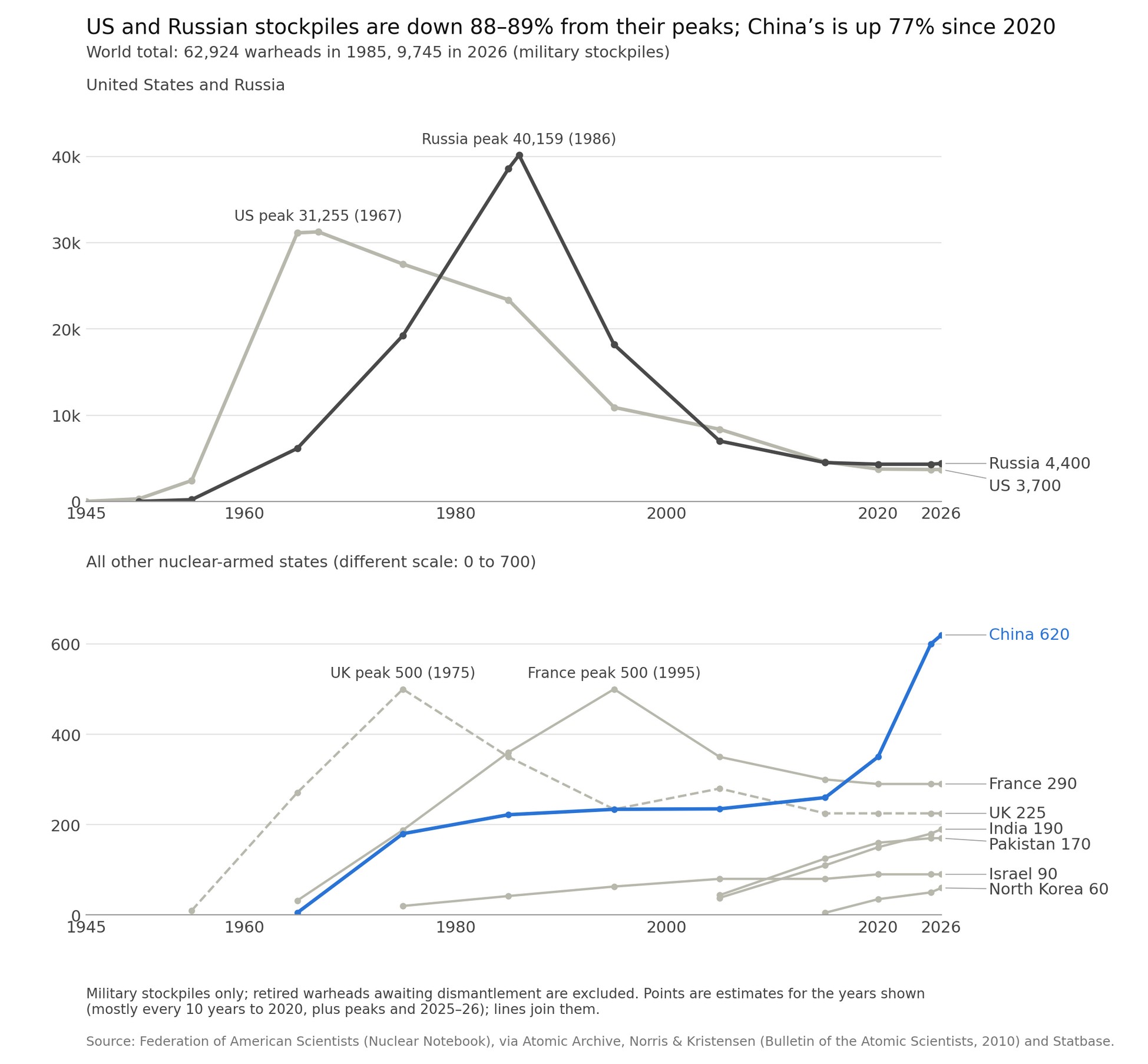
The numbers are the easiest part to see. Estimates from the Federation of American Scientists put the world's military stockpiles at two warheads in 1945 and about 64,000 in 1986. The American stockpile peaked at 31,255 in 1967 and the Soviet one at 40,159 in 1986.4 Then the numbers fell. By January 2026 the world total was 9,745, with roughly 3,700 American and 4,400 Russian warheads, each down about 88–89% from its peak.
Fewer weapons was only part of it. The weapons also became less ready. After 1991 both sides took large parts of their forces off alert, and SIPRI now estimates that between 2,100 and 2,200 warheads sit on high alert, out of 9,745 in stockpiles.5
In the mid-1990s the world was in about its safest position since the first bomb. The danger had not gone, but the three things that drive it, tension between nuclear powers, weapons ready to launch, and a lack of rules, were all pointing the right way at once.
What held it down
Arms control was the scaffolding. The Partial Test Ban Treaty came in 1963, the year after Cuba. The Non-Proliferation Treaty took effect in 1970. SALT I and the ABM Treaty, in 1972, capped the strategic race and limited missile defences. The INF Treaty of 1987 eliminated a whole class of intermediate-range missiles, and the US Senate ratified it 93 to 5.6 START I, in 1991, cut deep into strategic arsenals. New START, signed in 2010, held each side to 1,550 deployed warheads on 700 delivery vehicles.
The treaties did two jobs. They capped numbers, and they let each side see what the other was doing, through inspections and data exchanges. That second job matters in a crisis. A leader who can verify that the other side is not preparing a first strike is less likely to guess wrong under pressure.
The system was also built on talking. Presidents and foreign ministers met, delegations negotiated for years, and the habit of dialogue survived wars by proxy, spy scandals and the collapse of an empire.
The collapse of the Soviet Union in 1991 created a different danger: tens of thousands of warheads and tonnes of weapons-grade uranium in a country whose economy was falling apart. The answer was a deal that ran on money rather than treaty text. Under the 1993 HEU Purchase Agreement, Russia would convert 500 metric tons of highly enriched uranium from dismantled warheads into low-enriched reactor fuel, and the United States would buy it. Signed shortly after the Soviet collapse, it gave Russia a financial incentive to dismantle thousands of weapons,7 and it was meant to run on commercial terms without government funds.8 The US Enrichment Corporation and Russia's Tenex acted as the two governments' agents, and American monitors checked the blend-down at Russian plants.
The program, known as Megatons to Megawatts, finished on schedule in December 2013. By then 500 tonnes of uranium, equivalent to about 20,000 warheads, had become more than 15,000 tonnes of reactor fuel, and fuel made from it had supplied about 10% of US electricity.9 For twenty years Russia was paid to take warheads apart in the years it could least afford to, and the US was a customer for material that might otherwise have gone missing from a poorly guarded plant. The deal ended in 2013, a year before Crimea.
The unravelling
The scaffolding came down one piece at a time:
- 2002: the US leaves the ABM Treaty, the first major exit from a modern arms control agreement.10
- 2019: the INF Treaty ends after the US withdraws, alleging Russian violations that Russia denies.11
- 2020: the US leaves Open Skies, the treaty of mutual surveillance flights.
- 2023: Russia suspends its participation in New START12 and moves to revoke its ratification of the test-ban treaty.
- 2026: New START expires.
The last step was avoidable. In September 2025 Vladimir Putin offered to keep to New START's central limits informally for a year. Donald Trump first called it a good idea, but Washington never formally answered. It said it wanted a new treaty that also covered China and Russia's short-range weapons, and an under secretary of state added that the US keeps non-deployed capacity it could use if the president directs. Russia says it will stay within the old limits only as long as the US does.13 China says it will not join negotiations at this stage.
The ban on nuclear explosive testing is also under strain. On 30 October 2025 Trump ordered the Pentagon to resume testing "on an equal basis" with other countries, and Putin told his officials to prepare proposals in response.14 In February the US accused China of a low-yield test in 2020. China called the claim groundless, and the test-ban organisation said the seismic data alone could not show what caused the events.15 No explosive test by any state has been confirmed this year.
Meanwhile the weapons themselves are changing direction. SIPRI says all nine nuclear-armed states modernised in 2025, that states are "increasingly relying on nuclear weapons as instruments of national power", and that the global total is falling only because the US and Russia are still dismantling retired warheads, a process that is slowing as new deployments speed up. China has gone from about 600 to 620 warheads in a year and has loaded hundreds of missiles into silo fields. France has ordered more warheads and stopped publishing its total. And the 2026 review conference of the Non-Proliferation Treaty ended in May without an agreed outcome, the third in a row.5
Two wars and a standoff
Arms control seldom falls apart in a calm world, and this one is not calm. Two active wars involve nuclear-armed states.
Ukraine. Russia's war is in its fifth year. In January it fired the nuclear-capable Oreshnik missile at Lviv, close to the Polish border, and it used the missile again in May. A base for it is being built in Belarus.5 Diplomacy is moving, slowly. Putin met US envoy Steve Witkoff on 21 October, and Moscow and Kyiv both say they will resume US-mediated talks, probably in early November. Hours later Russia hit Kyiv with ballistic missiles and Ukraine sent hundreds of drones toward Moscow.16 Russia still demands all of the Donbas region.
Iran. The US and Israel began striking Iran on 28 February. A ceasefire in April and a memorandum in June did not end the war. Before the 2025 strikes the IAEA put Iran's stock at about 440 kg of uranium enriched to 60%. Its size and location are now unverified because inspectors have no access, and senior Iranian officials have questioned whether Iran should stay in the Non-Proliferation Treaty. US media report more forces heading to the region, which would give Trump strike options after the 3 November midterms.17
Taiwan. There has been no large Chinese exercise this year, but coast guard and research ships press in constantly. On 18 October twelve Chinese vessels and four fishing boats harassed Taiwanese ships.18 A US arms package worth about $14 billion is on hold, and Trump has called it a bargaining chip.19
South Asia and Korea. India and Pakistan fought briefly in May 2025, and India struck air bases likely to have nuclear roles. Both sides took steps to avoid escalation, but SIPRI says the clash challenges deterrence logic. North Korea has about 60 warheads and fissile material for at least 30 more.
None of these crises is new in kind. What is new is that they are playing out with the restraints removed.
Putting a number on it
A nuclear risk index shows how these pieces add up. It multiplies three things. The first is how much conflict there is among and around nuclear powers, coded from a log of crises since 1948. The second is how many warheads are ready to launch, on a log scale, because going from nothing to hundreds of ready weapons matters more than going from twenty thousand to thirty thousand. The third is how much of the risk is held back by treaties in force. Each is scored from 0 to 1.
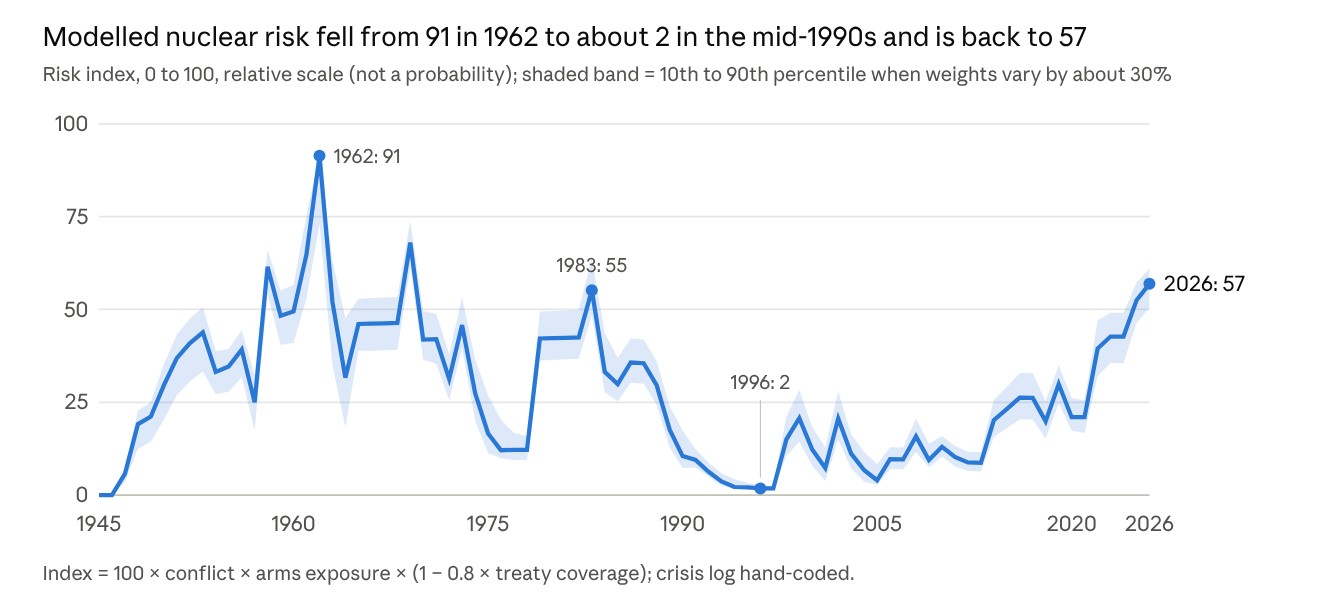
The Cuban Missile Crisis scores 91. The index falls through the détente of the 1970s, jumps to 55 in 1983 when the Able Archer exercise and new missile deployments in Europe frightened both sides, and sinks to about 2 in the mid-1990s, when treaties covered most of the field and almost no crisis involved nuclear powers. It starts to climb after Crimea in 2014 and rises steeply from 2022. For 2026 it gives 57, about the same as 1983, with a range of 50 to 61 across alternative weightings.
Three factors moved the wrong way at once. The conflict score went from 0.05 in 1995 to 0.91 in 2026. Treaty coverage fell from about 0.7 to 0.23. Arms exposure barely helped: arsenals are smaller and less alert than in the 1980s, but the score is still 0.77 against a peak of 1.0.
The index is a way to compare years, not a forecast. It rests on published stockpile estimates, treaty dates and a coded log of crises, and it gives the same shape under the alternative weightings tested: a deep fall followed by a steep rise.
What this does and does not say
None of this means nuclear war is likely this year. An index near 57 is about where 1983 stood, and 1983 passed without a launch. The point is the direction. The trend that cut the danger for three decades has reversed, and most of the safeguards that drove that fall are gone.
There are reasons not to be fatalistic. SIPRI notes that the big Russian build-up of short-range warheads predicted in 2020 has not happened, and a Russian Sarmat missile test failed in 2025. Russia says it will keep to the old New START limits as long as the US does. No explosive test by any state has been confirmed. And Moscow and Kyiv both say they will return to the table.
The same three levers that brought the risk down earlier are available now:
- Less conflict. The Ukraine and Iran wars are the biggest drivers of the 2026 score, so a ceasefire in either would move the number more than anything else.
- Restore restraint. Both governments could commit to stay within the old New START ceilings of 1,550 deployed warheads and 700 launchers while a new deal is negotiated, bring back inspections, and hold to the ban on explosive tests. In the model, restoring only the two New START terms cuts the 2026 score from 57 to about 46.
- Less readiness. The 2,100 to 2,200 warheads on high alert set how little time a leader has to decide. Taking some of them off alert costs little and was done in the early 1990s.
None of these needs a grand new treaty to begin. The next test is the trilateral US–Russia–Ukraine talks proposed for early November.